7-Day English Speaking Challenge at Home for Beginners
Want to speak English with more confidence? Follow this practical seven-day challenge at home with simple sentences, daily speaking exercises, mirror practice, and listening activities. Build a regular practice habit and discover how guided spoken English training in Ranchi can support your progress.
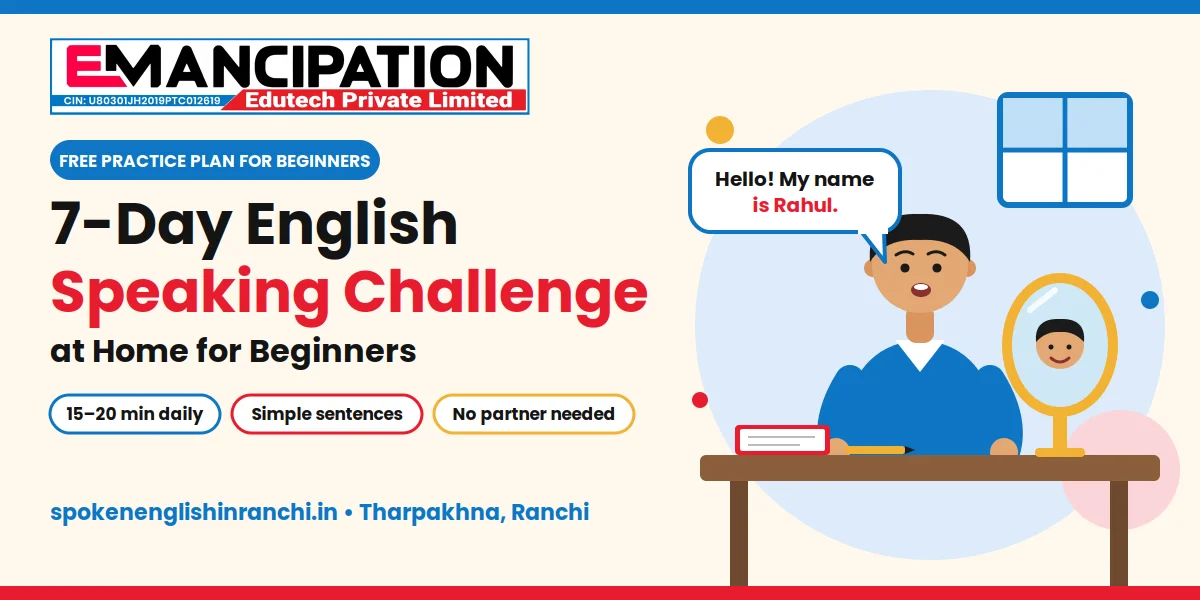
7-Day English Speaking Challenge at Home for Beginners
Have you ever known the answer to your teacher’s question
but stayed silent because you could not express it in English? You may
understand English lessons and know basic grammar, yet speaking in front of
classmates feels difficult.
Many students in Ranchi face this problem. They understand
English but hesitate when it is time to speak. They fear making mistakes,
forgetting words, or being laughed at by others.
The good news is that English speaking practice at home can
help you build confidence without expensive books or special equipment. You
only need 15–20 minutes daily and a willingness to practise.
This seven-day challenge will help you learn useful
sentences, practise everyday conversations, and develop a regular speaking
habit. Seven days will not make you fluent overnight, but they can help you
take the first step towards confident communication.
Why Do Beginners Struggle to Speak English?
Beginners often understand English but struggle to respond quickly. Common reasons include:
Thinking
in Hindi first: Translating every sentence word by word makes speaking
slower.
- Fear
of mistakes: Worrying about grammar can stop you from expressing your
thoughts.
- Limited
vocabulary: You may know words but struggle to combine them into
sentences.
- Insufficient
practice: Reading grammar rules cannot replace speaking regularly.
- Lack
of a speaking partner: Without conversation practice, it is difficult to
develop fluency.
Start with simple sentences instead of trying to sound perfect. The more regularly you practise, the more comfortable speaking can become.

Your Complete 7-Day English Speaking Challenge
Day 1: Introduce Yourself in English
Goal: Learn to introduce yourself confidently.
Start with your name, hometown, education, hobbies, and
future goals.
Practise this example:
“Hello, my name is Rahul. I live in Ranchi. I am a college
student. I enjoy playing cricket and listening to music. I want to improve my
English because I want to communicate confidently.”
Change the details to match your life. Read the introduction
aloud, then try speaking without looking at the text.
Your 15–20-minute task: Practise for ten minutes and record
a short introduction on your phone. Listen to it and identify one thing you
want to improve.
Day 2: Describe Your Daily Routine
Goal: Speak about everyday activities using simple English.
Familiar topics make speaking easier because you already
know what to say.
Practise these sentences:
- I
wake up early in the morning.
- I get
ready for college.
- I
attend my classes.
- I
study in the evening.
- I
help my family at home.
- I go
to bed at night.
Connect these sentences to describe your day.
Your task: Speak for one minute about your daily routine.
Practise once while reading and once without reading. If you forget a sentence,
use simpler words and continue.
Day 3: Think in Simple English
Goal: Reduce the habit of translating every sentence from
Hindi.
You do not need difficult vocabulary to start thinking in
English. Describe the objects around you and the activities you perform.
For example:
- I am
opening my book.
- I
need some water.
- My
phone is on the table.
- I am
going to college.
- I
have to complete my homework.
Look around your room and describe five objects aloud.
Your task: Speak ten simple sentences about your
surroundings or daily activities. Do not worry if you occasionally think in
Hindi. Focus on expressing small thoughts directly in English.
Day 4: Practise Everyday Conversations
Goal: Learn to ask questions and respond naturally.
Imagine meeting a classmate after a lecture.
A: Hi! How are you?
B: I am fine. How about you?
A: I am good. Did you attend today's class?
B: Yes, I did. The lecture was interesting.
A: What are you doing now?
B: I am going to the library to study.
Read both parts aloud and then change roles. You can also
create conversations about shopping, hobbies, or interview preparation.
Your task: Practise one short dialogue for 15–20 minutes. If
possible, ask a friend or family member to join you.
Day 5: Speak in Front of a Mirror
Goal: Become more comfortable speaking aloud.
Choose a familiar topic, such as your favourite subject, a
memorable day, or your future career. Stand in front of a mirror and speak as
if you are explaining something to a friend.
Remember these tips:
- Speak
slowly and clearly.
- Maintain
natural eye contact with your reflection.
- Use
words you already know.
- Avoid
restarting after every small mistake.
- Keep
your posture relaxed.
Your task: Speak for one minute about your favourite hobby. Repeat
the speech and notice whether you feel more comfortable the second time.
Day 6: Listen, Repeat, and Improve Pronunciation
Goal: Improve listening skills and pronunciation.
Choose a short English-learning audio clip or
beginner-friendly video. Listen to one sentence, pause, and repeat it aloud.
Practise expressions such as:
- Could
you please help me?
- I
would like to ask a question.
- Could
you say that again?
- Thank
you for explaining it.
Focus on clear pronunciation rather than copying a
particular accent.
Your task: Choose five sentences from an English audio or
video. Repeat each sentence several times and use two of them in your own
examples.
Day 7: Record Your Own English Speech
Goal: Review your progress and plan your next steps.
You have practised introductions, daily routines, simple
thoughts, conversations, mirror speaking, and listening. Now combine these
skills.
Record yourself speaking for one or two minutes about
yourself or what you learned during the week.
After listening, ask yourself:
- Can
I complete simple sentences more comfortably?
- Which
words are difficult to pronounce?
- Where
do I pause because I cannot find a word?
- What
has improved since Day 1?
Your task: Write down two things you did well and one area
to improve. Save your recording so you can compare it with a future recording.
How to Practise English Without a Speaking Partner
You can practise independently even if nobody at home speaks
English.
Describe your activities aloud, read short passages, record
voice notes, and repeat sentences after English-learning audio. You can also
imagine everyday situations and practise both sides of a conversation.
However, self-practice has limitations. You may not notice
repeated grammatical or pronunciation errors. Regular conversations and
constructive feedback can help you identify mistakes and improve more
effectively.
How Emancipation Training Centre Helps Students in Ranchi
Home practice is an excellent starting point, but some
learners benefit from structured training and regular interaction.
Emancipation Training Centre, located in Tharpakhna, near
Govt. Women’s College, Ranchi, helps learners develop practical English
communication skills and confidence.
Training focuses on:
- Interactive
spoken English and conversation practice.
- Grammar
fundamentals and vocabulary building.
- Pronunciation
and clear communication.
- Personality
development and confidence-building activities.
- Interview preparation and mock interviews.
- Personal
guidance and opportunities to practise speaking.
Whether you are a college student, fresh graduate, or job
seeker, guided practice can help you prepare for presentations, classroom
discussions, and professional conversations.
If you are looking for an English speaking course in Ranchi,
visit spokenenglishinranchi.in
to learn more about the training programmes.
Frequently Asked Questions
1. Can I improve my English speaking at home in seven
days?
Yes. You can begin building confidence and develop a
speaking habit in seven days. Fluency requires consistent practice over a
longer period.
2. How many minutes should a beginner practise English
daily?
Start with 15–20 minutes daily. Choose activities that you
can continue comfortably and consistently.
3. How can I speak English without translating from
Hindi?
Describe familiar objects and activities using simple
English. Gradually practise forming short thoughts directly in English rather
than translating every word.
4. Should I learn grammar before starting English
speaking practice?
No. Learn basic grammar alongside speaking practice. Begin
with simple sentences, practise conversations, and correct mistakes as you
improve.
Start Your English Speaking Journey Today
You do not need perfect English to begin. You need patience,
regular practice, and the courage to speak even when you make mistakes.
Start your seven-day challenge today and give yourself 15–20
minutes to practise. If you need structured guidance, interactive sessions, and
feedback, Emancipation Training Centre in Tharpakhna, Ranchi, can help you work
towards better communication and confidence.
Visit spokenenglishinranchi.in to explore your learning options.